
Wabash County Jail Release Paths
Wabash County Jail is the local booking and detention point. A name can leave its current list because a judge ordered pretrial release, a sentence ended, custody credit satisfied the term, charges ended, probation began, or another custodian took control. The jail record should state the physical event. The Second Judicial Circuit file supplies the order or disposition behind it.
A transfer must stay separate from a community release. If IDOC receives a sentenced person, the county jail entry may show an exit while the IDOC profile shows continued confinement. A transfer to another county, federal custody, or immigration custody has the same core problem: the person left this jail but did not necessarily become free in the community.
| Possible path | Record to confirm it |
|---|---|
| Pretrial release with conditions | Jail event and court release order |
| Time served or sentence completion | Release sheet, judgment, and custody-credit finding |
| Dismissal or probation | Docket, signed disposition, and jail exit |
| Transfer to IDOC | County destination field and IDOC admission or status |
| Other-authority transfer | County destination and receiving-agency record |
Confirm Wabash County Jail Release
The sheriff's official roster page says public roster access is exclusive to the Wabash County Sheriff's Office mobile app. It advertises a current inmate list, booking details, charges, bond information, and real-time updates. It does not advertise a 24-hour or 72-hour released list, browser archive, release date, release type, photo, retention period, or fixed refresh schedule.
- Search the app for current presence, using exact and reasonable name forms, and note the date of the search.
- Call 618-262-5531 and ask whether the person is currently held and which public record identifies an exit or transfer.
- Request the booking and release record, including event time, disposition, and destination.
- Check the Wabash Circuit Clerk's docket and obtain the order that explains the legal basis.
- If transfer is possible, compare IDOC, BOP, ICE, or another receiving authority.
The full Wabash County released-inmate search and records path explains how to reconcile conflicting dates and distinguish county, state, federal, and immigration sources.
Wabash County Jail Records Contact
Use the jail for immediate custody questions and the sheriff's office for the current records-request route. The official site reviewed did not publish a sheriff-specific FOIA form, named FOIA officer, copying rate, office hours, or booking-photo policy. Call first when the delivery method is unclear.
Wabash County Jail110 E. Fourth Street
Mt. Carmel, IL 62863
618-262-5531 Wabash County Sheriff's Office
120 E. Fourth Street
Mt. Carmel, IL 62863
618-262-2706
Describe an existing record rather than asking staff to create a report. Give the full name and, when known, date of birth, booking number, and booking date. Ask for the booking date and time, release date and time, recorded release disposition or destination, booking or release sheet, and booking photograph as separately described records.
Under Illinois FOIA, ask the sheriff to redact exempt material, produce the nonexempt remainder, and identify the exemption used. A noncommercial request generally receives a response within five business days, subject to a statutory extension and other lawful response types. No Wabash-specific release-record or photograph fee was verified.
Wabash County Jail Record Fields
The most useful release record ties one identity and booking episode to a physical exit. Exact database labels can differ, so the request should describe the facts needed rather than assume the jail uses a particular menu.
| Requested field | Why it matters |
|---|---|
| Name and booking number | Prevents a same-name record mix-up. |
| Booking date and time | Defines the correct county custody episode. |
| Release date and time | Documents the jail's recorded physical exit. |
| Disposition or destination | Separates community release from transfer. |
| Court or case identifier | Connects the jail event to its legal basis. |
| Booking photograph | Requires its own access and redaction decision. |
The court order and jail time can differ. A judge may enter an order before release processing is complete, and an unrelated hold may delay departure. Preserve both times and ask the originating office to explain any unresolved conflict.
For a recent event, build a short timeline from the booking time, detention hearing or order, physical jail exit, stated destination, and any later receiving-agency admission. A VINE notice or app change can arrive after the source event. That lag is not a reason to force each timestamp to match. Record which office supplied each time and whether it reflects an event or data entry.
Older Wabash County Jail releases call for a different route. A current-only app cannot establish a disposition from months or years ago. Start with the circuit clerk using the name, approximate year, and case number when known. Ask for the register of actions and the actual disposition or sentencing order. Then request the jail event if the exact exit time or destination remains important. If the jail no longer holds the item, ask which approved retention series or repository applies.
Wabash County Jail Pretrial Release
The Wabash County Jail FAQ explains that Illinois ended cash bail effective September 18, 2023. A detention hearing determines whether a person remains detained or leaves under pretrial conditions. For a modern Wabash County case, “pretrial release” is more precise than assuming the person paid bond.
The FAQ also says older warrants may retain cash-bond terms. Verify the specific warrant and order. The local Office of Statewide Pretrial Services may administer release conditions, but that role does not replace the court's signed order or the jail's release event.
The official FAQ also documents the separate transfer-property process.
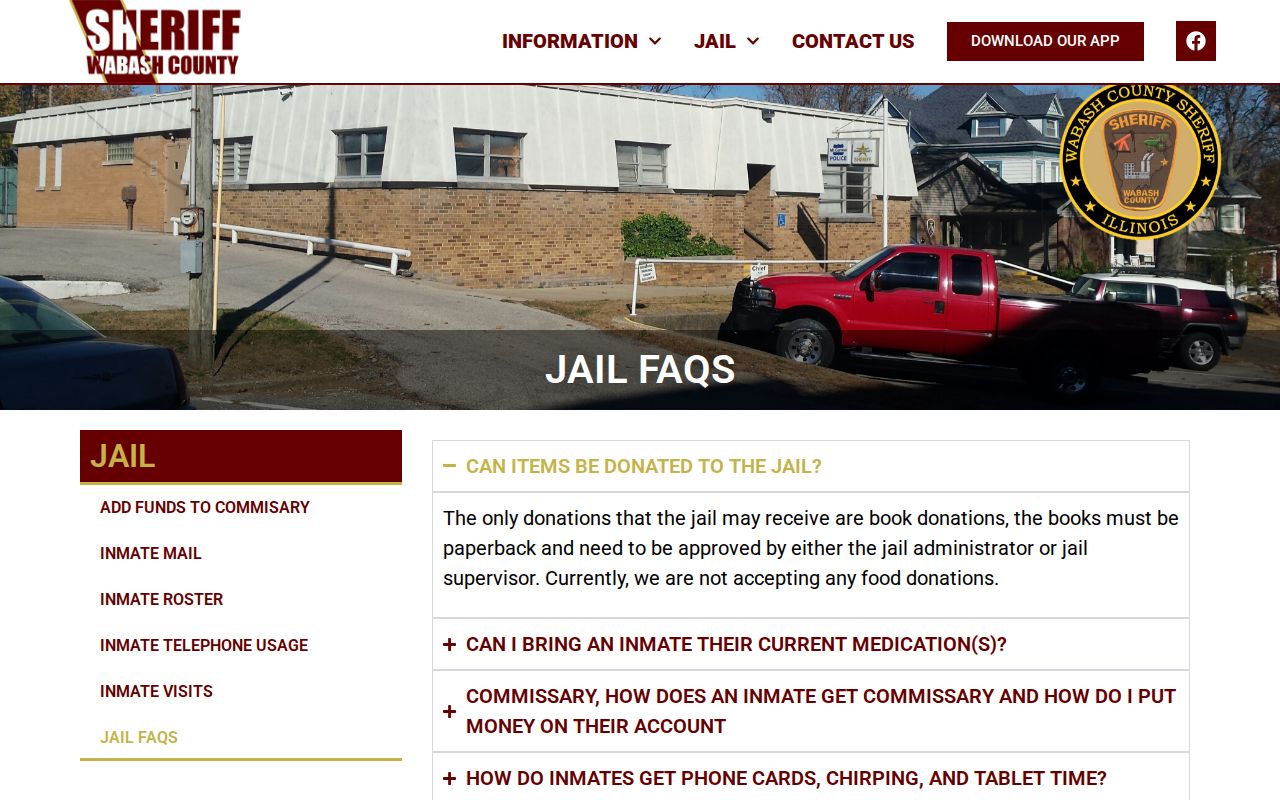
Its pretrial and transfer statements answer different questions and should not be merged into one community-release procedure.
Wabash Jail IDOC Transfer Property
For an IDOC transfer, the Wabash FAQ says specified identity and essential property may go with the detainee. The listed items include identification or driver's license, Social Security card, birth certificate, legal or privileged mail, a religious book, address book, dentures and case, glasses and case, and a qualifying wedding band.
Property that does not travel is held for a designee for 30 days and disposed of on day 31. That deadline supplies a concrete step after a confirmed state transfer. It does not establish the property process for a person released straight to the community, and it says nothing about release transportation, an exit door, or a daily release time.
Note: Confirm the IDOC transfer before applying this narrow property rule or its pickup deadline.
Wabash County Jail Facility Facts
The October 10, 2024 IDOC inspection identifies the Wabash County Jail as a 1974 facility with 20 rated beds, divided into 16 male and four female spaces. Nine people were present on the inspection day. The report states that the jail did not house people for other entities and identifies Jail Administrator James Sullivan.
These are facility facts, not annual release totals or average-stay figures. No official release door, daily schedule, weekend release method, family waiting site, transportation benefit, or gate-money policy was found. State inspection checklist topics also should not be converted into a claim about what occurred in one person's case unless the marked finding is verified.
The inspection's statement that Wabash County Jail did not house for other entities narrows the facility description, but it does not prove that no person can ever pass through another authority's custody. A court can still send a Wabash defendant to IDOC, and another jurisdiction can still receive a transfer. Treat the inspection as a dated facility snapshot and use the named person's records for the actual custody chain.
Identify Wabash County Jail Correctly
Only this county jail was verified as a physical detention facility inside Wabash County through the official local and IDOC sources reviewed. No municipal lockup, Illinois state prison, federal prison, or ICE detention facility was identified in the county. That does not prevent transfer elsewhere.
Do not confuse the Mt. Carmel, Illinois jail with Wabash Valley Correctional Facility in Indiana. Match the state, operator, address, booking number, and case before joining records. A Wabash County sentence listed in an IDOC profile means the state mittimus came from this county. It does not mean the person remains at the county jail.
A current roster result, a court order, and a receiving record form a custody chain. When all three agree, they give a stronger answer than any single name search. When they conflict, preserve each sourced value and ask the office that created it to clarify.
Identity controls every step. Compare the full name with date of birth or age, booking number, case number, and other available descriptors. A county booking number is not an IDOC number, a federal register number, or a court case number. Entering one agency's identifier into another agency's system can produce a no-result that says nothing about release. Common names need at least two meaningful identifiers before records are joined.