
Federal Releases Connected to Wabash County
A federal case can begin with arrest or temporary detention in a local or contract facility, then move through the U.S. Marshals Service and into BOP. The BOP locator becomes the right public release route only after the person has a federal prison record. It does not document an exit from Wabash County Jail unless that county event became part of a later BOP custody path.
A county roster disappearance may instead mean community release, transfer to IDOC, another county, federal custody, or immigration custody. No physical federal prison was found in Wabash County, and no local ICE detention contract was established by the reviewed sources. The system name on the result matters more than the county where the case or arrest began.
How to Confirm a Federal Release for a Wabash County Person
The official locator supports identifier and biographical searches. An identifier is stronger when it is known, while a name search needs added identity controls.
- Open the BOP Inmate Locator.
- Search by BOP register number, DCDC number, FBI number, or INS number when available. Otherwise use name, age, race, and sex.
- Compare the returned name, register number, age, race, and sex. Do not accept a common-name match without a second meaningful identifier.
- Read the location field and release date together. A location of
RELEASEDmeans the person is no longer in BOP custody. - Determine whether the date is past or future. A past date with no facility supports a completed BOP release; a future date remains projected.
- Check for
UNKNOWNorIN TRANSIT. Neither is a community-release confirmation. - Save a dated copy of the result and the BOP field explanation. For facts beyond the locator, use the BOP records process.
If the custody origin is uncertain, the Wabash County released-inmate search path shows how to compare the local jail event with court, IDOC, BOP, and ICE records.
What BOP Release Fields Mean in a Wabash Search
BOP publishes specific meanings for its locator fields. Use those meanings instead of replacing them with a broad phrase such as “not in custody” on every result.
| BOP display | Meaning | What it does not prove |
|---|---|---|
| RELEASED with a past date | The person is no longer in BOP custody and BOP reports release on that date | No federal supervision or no later state, local, or immigration custody |
| Future release date | A projected BOP date | That release already occurred |
| UNKNOWN | The confinement term is not determined in the locator | Release, sentence completion, or lack of custody |
| IN TRANSIT | The person may be moving under BOP or another authority | Community release |
| Facility location | The facility context currently supplied by BOP | Custody at Wabash County Jail |
BOP extracts information from its main database and updates the locator daily. Daily updating does not guarantee that every outside agency event appears at once. Record the date checked and return to the source if a transfer or recent court event may not yet be reflected.
BOP Released-Person Search Evidence
The official locator page below is the federal search route. It offers the identifier and name-based methods described by BOP.
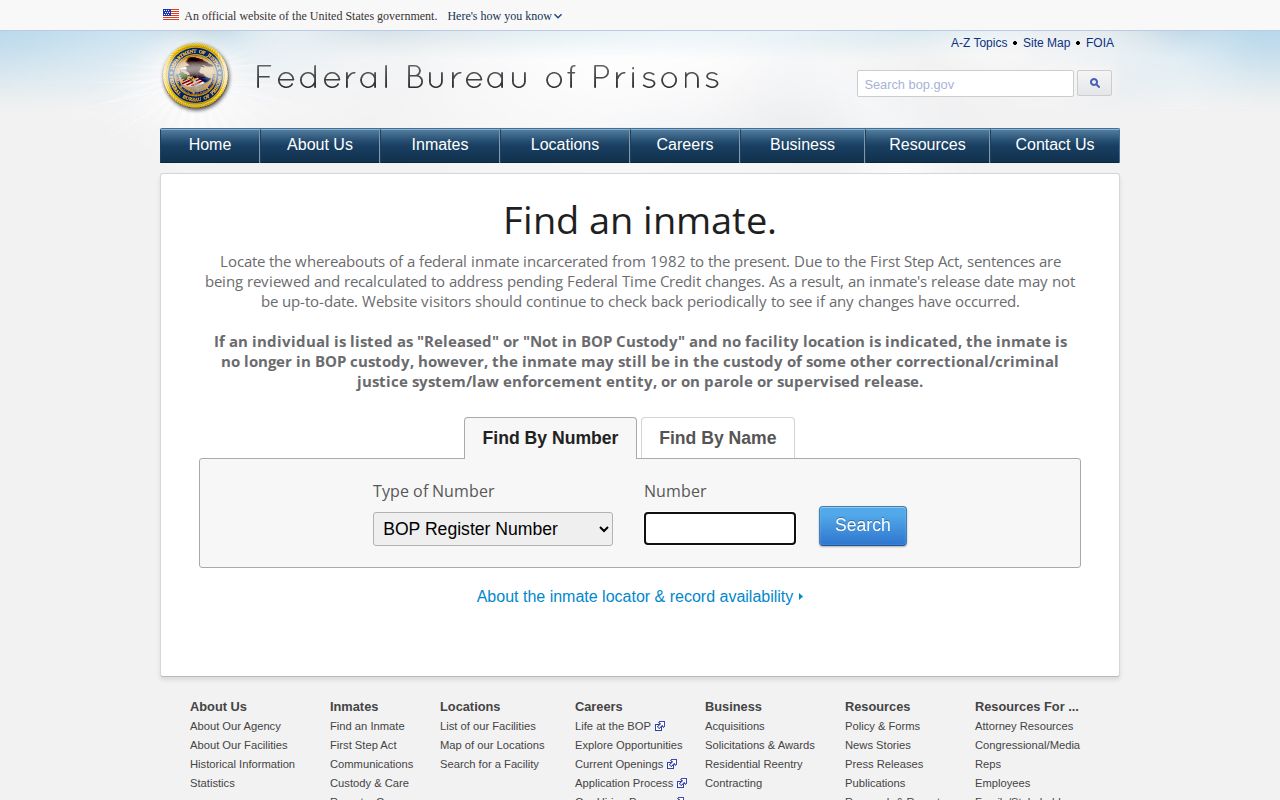
A result should be matched to the person before its date or location is used. The locator does not search Wabash County jail-management records.
BOP's own records explanation supplies the scope and field definitions. The captured page below is important when a result uses RELEASED, UNKNOWN, or IN TRANSIT.
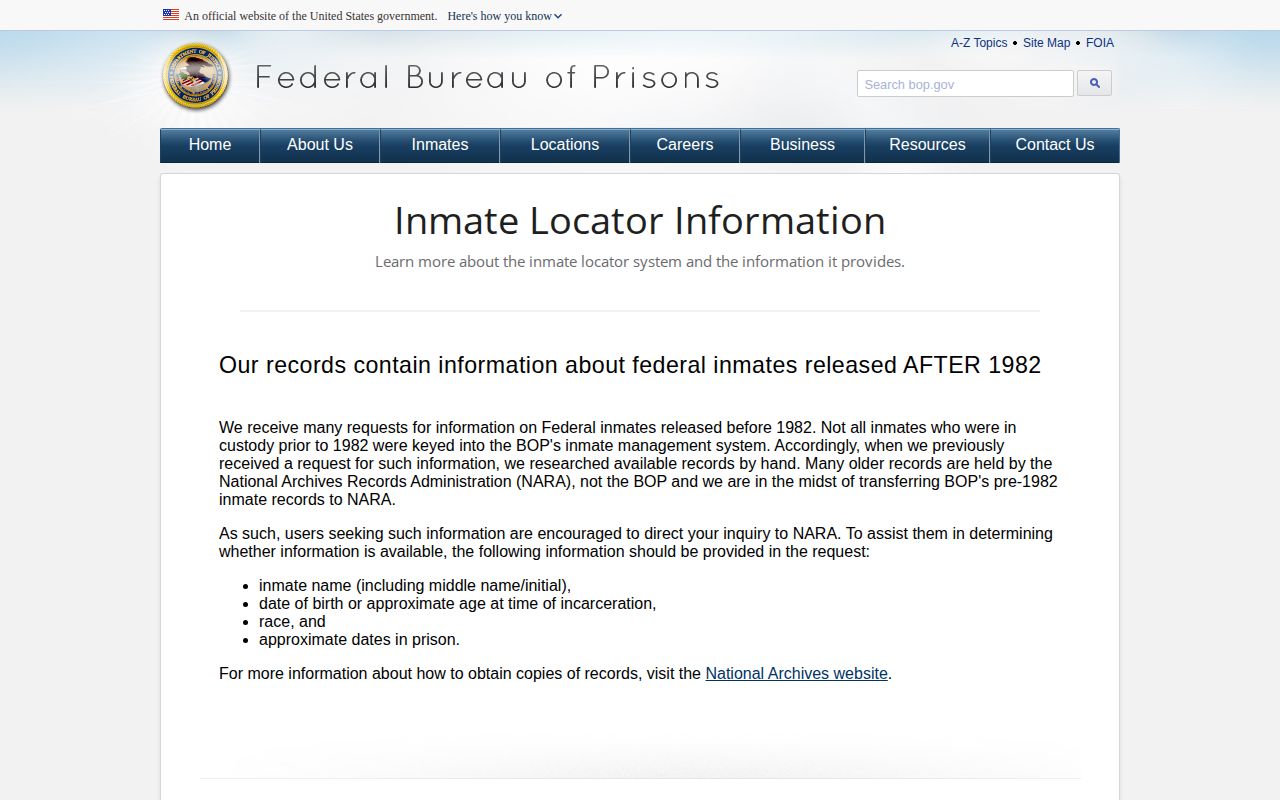
Keep the explanatory page with the named result so a status is not later interpreted beyond its official meaning.
Historic Federal Release Records and Wabash County
The online locator's released-person coverage focuses on releases after 1982. Many older records are held by the National Archives. A failed search for an older person therefore may reflect the online scope rather than the absence of a federal record.
For a recent no-match, check spelling, middle names, suffixes, age, and the federal identifier. A county booking number will not work as a BOP register number. For an older case, follow BOP's referral to the National Archives. Preserve the federal court case number when known because it can connect the docket, marshals path, and BOP identity.
No-result language must remain narrow. It does not prove release, prove that a person never entered federal custody, or establish the date a federal obligation ended.
Note: BOP's post-1982 online scope makes event age a key part of every failed federal release search.
Federal Release Records and BOP FOIA
For information beyond the locator, use the BOP Freedom of Information Act route. Describe the existing record sought, identify the person precisely, and request the relevant federal release or custody facts. BOP may require identity certification such as DOJ-361, depending on the requester and record.
A focused request is more useful than asking the agency to answer a broad question. Specify the register number, full name, known birthdate, and the release or custody record and date range. Privacy and other federal access limits still apply. The existence of internal information does not guarantee that every detail is releasable.
Federal Bureau of Prisons Records Channels
Public search: BOP Inmate Locator
Field guidance: About Federal Inmate Records
Additional records: BOP FOIA and, for older holdings, the National Archives
Supervision After a Federal BOP Release
A BOP release does not exclude federal supervised release. BOP custody and court-ordered federal supervision are different stages. The locator reports the BOP custody record, while the federal judgment and supervising court or probation office govern any post-prison supervision.
Likewise, a past BOP date does not rule out a later arrest or transfer to state, local, or immigration custody. If the result matters to a current whereabouts question, compare the date with a current court docket and the relevant receiving system. Do not present an old BOP release as proof of present location.
RELEASED means no longer in BOP custody. It is not a universal statement that the person has no supervision or custody anywhere.Federal Transfer, USMS, and ICE Distinctions
The U.S. Marshals Service transports and holds federal detainees through partner and contract facilities, but it has no general public locator comparable to BOP. When a federal defendant has not yet entered BOP, the federal court docket, the relevant marshal district, and the receiving facility form the practical chain.
ICE is a separate immigration system. If a Wabash County jail exit was a transfer to immigration authority, county-list absence is not community release. The ICE locator uses an A-number and country of birth or exact biographical fields and has distinct privacy and scope limits. BOP RELEASED also does not exclude a later immigration transfer.
Use the agency that actually holds the person and keep each identifier separate. The lack of a BOP match cannot answer an ICE, USMS, county, or IDOC custody question.
Identity Controls for Wabash County Federal Records
Federal release research must prevent a Wabash name match from becoming a false identity claim. Compare the BOP register number and age with the full name, including middle names, suffixes, hyphens, and alternate spellings. Race and sex are locator fields but should not be used alone. If a federal court case number is available, retain it as a separate identifier that can connect the docket to the correct BOP record.
A local case reference does not convert a county identifier into a federal one. Wabash booking numbers belong to the sheriff, IDOC numbers belong to Illinois corrections, BOP register numbers belong to the federal prison system, and ICE A-numbers belong to immigration records. Entering one type in another system can create a blank search that says nothing about release.
Event age also controls the next step. For a recent federal event, compare the locator with the court docket, marshals path, and named receiving facility. For a release after 1982, the BOP locator may retain the past date and RELEASED location. For an older federal event, follow the National Archives route. At every stage, state the narrow result: the record identifies a BOP release, a projected date, a transfer status, or no result within that channel. It does not establish a wider current status without a current-source check.