
Wabash County Releases Through the IDOC System
A Wabash County defendant may move from the county jail into IDOC after a prison sentence. That movement is a transfer into state custody, not release to the community. A later IDOC profile showing current PAROLE status, an actual Parole Date, and a parole district can confirm exit from prison to community supervision. Final sentence discharge is a later and distinct event.
IDOC also contains records for people whose Illinois prison cases have no Wabash connection. A sentence block that lists Wabash County indicates the source of that particular mittimus. It does not show that the person is housed at Wabash County Jail or that every sentence on the profile came from Wabash.
How to Confirm an IDOC Release Linked to Wabash County
Use the official public search as the first check, then seek written confirmation when the result will be retained as proof. Search terms and current status must be read together.
- Open the IDOC Individual in Custody Search.
- Select Last Name, IDOC Number, or Birthdate, enter the value, and choose Find.
- Open the correct match only after comparing the full name, birthdate, IDOC number, and available physical details.
- Read
Offender StatusandLocationbefore any historic or projected date. - Review
ADMISSION / RELEASE / DISCHARGE INFOand every sentence block, including the county and whether a count is discharged. - For prison exit, look for current
PAROLE, the actualParole Date, and the parole district. TreatProjected Discharge Dateas a forecast. - Save the date checked and contact IDOC for written confirmation if the public record is incomplete or no longer available.
The Wabash County released-inmate guide explains how to connect a county jail exit, Wabash court order, and later state admission without mistaking transfer for community release.
IDOC Release Fields for Wabash County Sentences
IDOC results combine current and historic facts. The top-level status controls interpretation. A discharged sentence count or an old parole date does not prove the person is out now if another sentence or later custody event remains active.
| Field | Use in release verification |
|---|---|
| Offender Status | Read first for the current state status |
| Location | Shows a facility or parole district context |
| Admission Date | Marks the state admission recorded by IDOC |
| Projected Parole Date | Forecast of prison release, not proof of exit |
| Last Paroled Date | Historic parole information that may not describe current status |
| Parole Date | Actual date shown on a parole profile |
| Projected Discharge Date | Forecast of the end of sentence or supervision |
| SENTENCE DISCHARGED?: YES/NO | Applies to a sentence block, not automatically the whole profile |
The official captured example below shows projected parole and discharge labels on an in-custody record. It is a field example, not a Wabash County release claim.
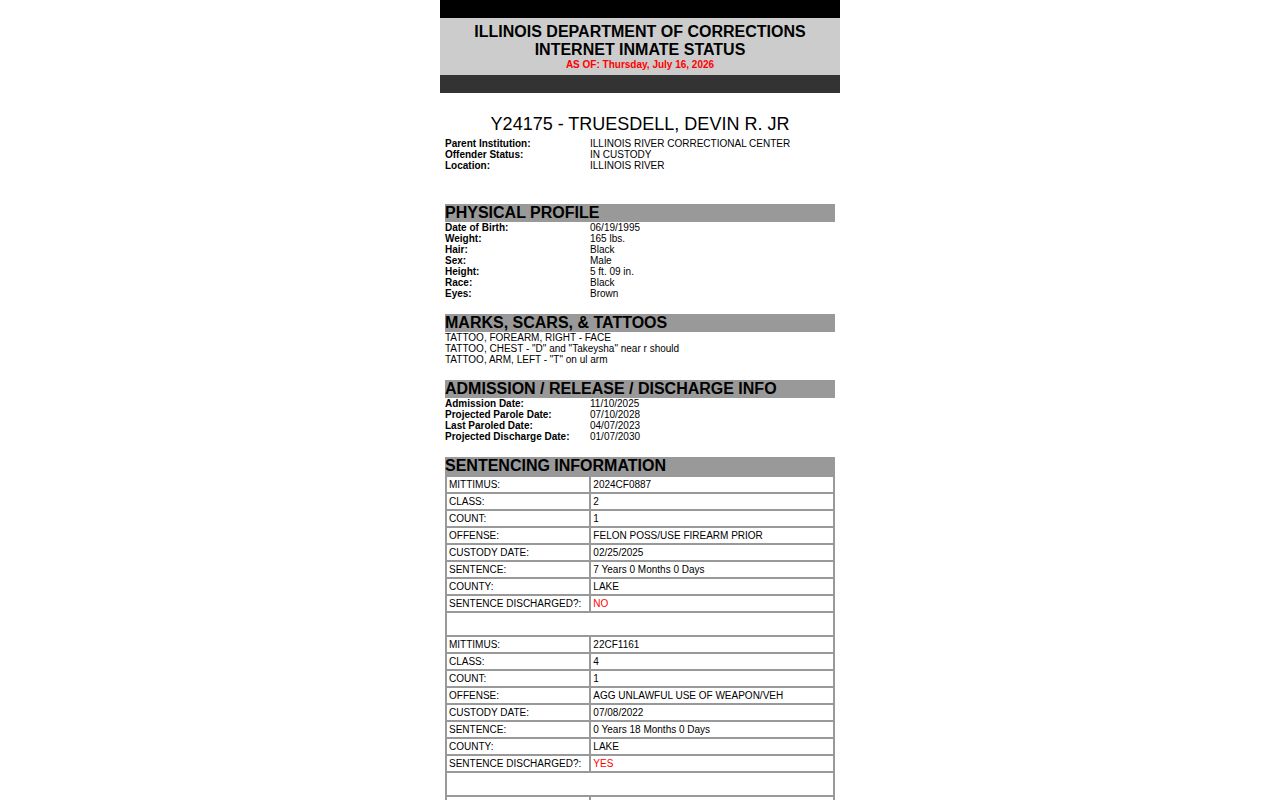
Return to the named person's current profile, since sentence credit, a court order, a new term, return to custody, or correction can change the display.
Projected Dates in IDOC Wabash County Records
IDOC calls its public estimate Projected Parole Date. Its use of the word parole does not mean every modern determinate prisoner receives a discretionary parole-board grant. Many leave imprisonment for mandatory supervised release after serving the term less authorized sentence credit.
Illinois credit is offense-specific under 730 ILCS 5/3-6-3. The law includes categories commonly described as 100 percent, roughly 85 percent, roughly 75 percent, and day-for-day, with statutory qualifications and exceptions. An individual's date also depends on the offense and sentence dates, jail credit, concurrent or consecutive structure, credit awards or losses, court orders, lost time, and data corrections. A general percentage cannot lawfully reconstruct a person's release date.
IDOC states that it cannot predict whether or when Earned Discretionary Sentence Credit will be awarded. If the date is revised, IDOC updates the profile and notifies the person. The dedicated Release Date Lookup explains the state labels and calculation limits in more detail.
IDOC Records and Contact for Wabash County Cases
IDOC warns that public search information changes quickly and recommends written correspondence before assuming it is factual and complete. The search can also be temporarily unavailable during maintenance or updates. The main number is the appropriate fallback for access problems.
Illinois Department of Corrections
Public Information mail: 1301 Concordia Court, PO Box 19277, Springfield, IL 62794-9277
Main phone: 217-558-2200
Parole office or agent: 800-666-6744
IDOC Freedom of Information Act Office
Email: DOC.FOIARequest@illinois.gov
Mail: IDOC FOIA Officer, 1301 Concordia Court, PO Box 19277, Springfield, IL 62794-9277
Status, inspection, and fee questions: 217-558-2200 ext. 4004
Ask narrowly for releasable admission, release, or discharge dates and identify the person with reliable details. IDOC's master-file statute includes release plans and final-discharge circumstances but generally treats the file as confidential except for specified access. A field's existence does not promise public production.
When a Wabash County IDOC Search Has No Match
The public IDOC search is not a complete archive of all former prisoners. IDOC describes the public scope as disclosable information about people incarcerated or on parole. Someone who reached final discharge may no longer return. Name variants, a wrong birthdate, a maintenance period, and a data correction can also produce a failed search.
Try the IDOC number when known, and test lawful name variants without merging two people. If a fully discharged record is the goal, request written confirmation from IDOC. Do not turn a blank result into claims that the person never entered state custody, was released on a certain date, or has completed every obligation.
Note: Keep county booking numbers, IDOC numbers, court case numbers, BOP register numbers, and ICE A-numbers in separate fields.
Parole and Final Discharge After an IDOC Release
A profile showing PAROLE confirms a current state supervision status, not final discharge. The parole district helps identify the supervising route. Day-to-day parole and MSR supervision belongs to the IDOC Parole Division. The Illinois Prisoner Review Board handles specified parole and revocation decisions, so its agenda or result is not a substitute for the current IDOC status.
A Projected Discharge Date remains future-facing. If the public profile later disappears, seek written confirmation of releasable final-discharge facts. A return to custody or a new sentence can change the top-level status after a genuine earlier prison release.
IDOC Written Proof for Wabash County Release Events
A durable state release check should preserve the public profile and ask for only the releasable facts needed to confirm the event. Identify the person by full name, IDOC number, and birthdate when appropriate. Specify the Wabash County sentence or mittimus if it is the link to the case. Ask for the recorded admission date, actual release or parole date, current status, and final-discharge date if that fact is releasable. A narrow request is more likely to reach an existing record than a request asking IDOC to explain a person’s full history.
IDOC master files receive special treatment under 730 ILCS 5/3-5-1. The statute identifies material such as parole release plans, reports, and the date and circumstances of final discharge, yet it makes the master file confidential except for defined access, subpoena, and court-order routes. The research therefore supports asking for segregable, releasable dates while avoiding a promise that IDOC must produce the entire file. IDOC also states that photos of former individuals in custody are confidential, so a release-record request should not promise a former-custody image.
Constituent Services is a separate contact route. IDOC lists 1000 E. Converse Avenue with PO Box 19277, Springfield, IL 62794-9277; 217-558-2200 options 1 or 2, or extension 67031; and DOC.Constituent.Services@illinois.gov. Published hours are 8:00 a.m. to 4:00 p.m. Monday through Friday, and the office requests 48 business hours for a response. Those contacts can help route a question, but the public profile or formal records response remains the proof.
When the county jail transferred the person to IDOC, preserve both sides of the chain. The Wabash booking or release sheet should identify the county exit or destination, and the later state profile should show admission into IDOC. The jail’s property rule can be a practical clue because specified identity and essential items may travel with the transferee while remaining property is held for a designee for 30 days and disposed of on day 31. Property handling alone does not prove the transfer.