
Wabash 24-Hour Release List
The Wabash County Sheriff roster page directs the public to its mobile app for a current inmate list. It does not publish a browser-based 24-hour release list, an archive, or a stated daily window. It also does not document release date, time, type, or destination as app fields. The advertised material is limited to the current list, booking details, charges, bond information, and “real-time updates.” That phrase is not a measured update schedule.
A roster disappearance is useful as a lead, but not as a release record. A judge may order pretrial release, a sentence may end, charges may be dismissed, or another agency may take custody. A correction to data can also remove a listing. The Wabash County Jail booking and release sheet is the direct record of the event. The criminal case identifies the legal basis.
Check Wabash Same-Day Releases
Use a short evidence chain when the question is whether a named person left during the prior day. The official roster explanation is the starting point for current status, but the jail and court are the sources that can turn an absence into a supported conclusion.
- Search the official sheriff app for the full name and review any matching current booking details.
- Call Wabash County Jail at 618-262-5531. Ask whether the person remains there and whether the recorded event was release or transfer.
- Contact the Wabash Circuit Clerk at 618-262-5362 for the order or docket entry that explains the change.
- Request the booking and release sheet, including release date and time, disposition, and destination when recorded.
- Check the IDOC offender search, BOP locator, or ICE locator if transfer is possible.
- Save a date-stamped copy of the official result or record response.
For a search focused on one named person across older records, return to the Wabash County released inmate search. The 72-Hour Releases page provides the wider three-day workflow.
Wabash Release Fields Confirmed
The app's promoted fields should not be confused with an official release-list schema. The table distinguishes what is documented from what must be obtained through a direct record request.
| Field | Official status |
|---|---|
| Current inmate list | Advertised in the sheriff app |
| Booking details | Advertised, but exact subfields are not defined |
| Charges and bond | Advertised current-booking categories |
| Release date and time | Not promised in the app; request the release sheet |
| Release reason or type | Not promised; compare jail record and court order |
| Destination or receiving agency | Not promised; ask jail and check the receiving system |
| Booking photograph | Not confirmed as an app feature |
A records request should identify the person by full name and, if known, birth date, booking number, and booking date. Ask for existing records rather than asking staff to create a report or answer a broad question. Nonexempt parts may be produced with protected matter redacted.
Wabash Pretrial Release Language
The Wabash jail FAQ gives a specific local reason to use careful language. Under Illinois's post-September 2023 process, a detention hearing can result in release under pretrial conditions rather than payment of cash bond. Older warrants may still contain cash-bond terms. Therefore, “pretrial release” is more accurate than saying a person “bonded out” unless the actual Wabash record uses bond language.
Statewide Pretrial Services may administer court-ordered conditions. The Wabash pretrial office listing names the local channel. It does not record the physical jail exit. The jail record, court order, and pretrial record answer different parts of the same event.
- Pretrial release
- Release before final case disposition under conditions set by the court.
- Transfer
- A move to another custodian, not a release into the community.
- Disposition
- The court action that resolves or changes the case.
Wabash Sheriff App Limits
Wabash's digital approach is unusually app-centered. The county maintains named iOS and Android apps. The sheriff's own page controls the feature claims, not stray wording in an app-store listing. Neither official source reviewed promises a recent-release archive or booking photographs.
The official iOS listing provides a useful view of the app access point:
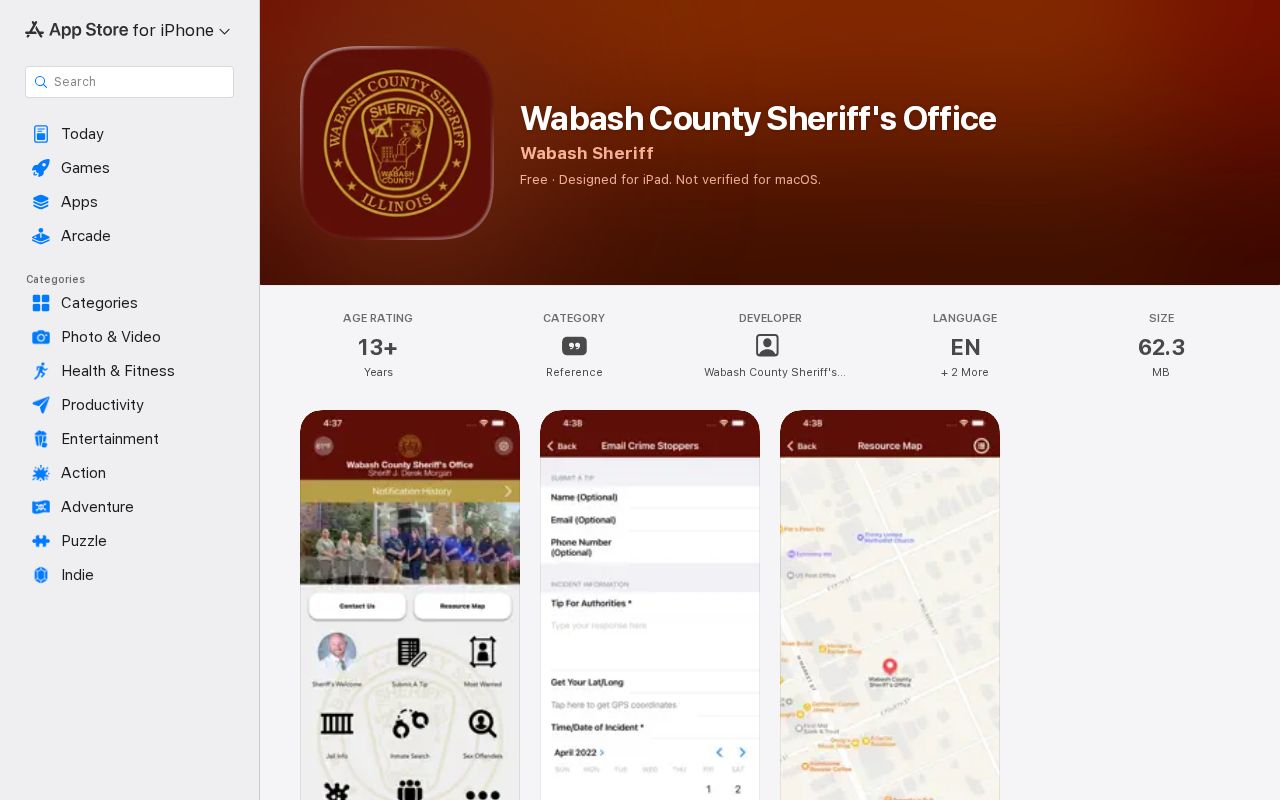
The image confirms where the mobile product is obtained. It does not transform a current roster into a released-inmate list, and it does not establish a release event by itself.
The phrase “real-time updates” should be read narrowly. The sheriff does not publish a measured refresh interval, a daily cut-off, or a guarantee that the instant a name disappears equals the recorded release time. Capture the access time, then request the actual event field. A mobile screen is a current observation, while a release sheet is a durable agency record.
The sheriff homepage also carries an official social and news stream. It may show selected arrests, warrants, or agency notices. That stream is not comprehensive and does not promise all same-day releases. An arrest-time post can remain visible after the case or custody status changes, so it cannot substitute for the release record.
If the app is unavailable, call the jail rather than turning to an unofficial list. The jail can address current local custody. The clerk can supply the order. A receiving-agency search can then test transfer. This fallback preserves the meaning of each source without filling the missing feed with guesses.
Wabash Custody Versus Release
A person still listed in the Wabash app is presented as currently held. Someone absent may have entered the community, but may also be in IDOC, another county, federal custody, or immigration custody. For IDOC, search by last name, IDOC number, or birth date and read the top-level offender status. A profile marked parole can show an actual Parole Date and parole district. A projected date is only a forecast.
Illinois VINE is another named-person and alert channel. Use the VINE Inmate Check for a participating agency result, but confirm “out of custody” or transfer wording with the source agency. Official material establishes IDOC coverage; Wabash County Jail participation was not expressly confirmed in the reviewed sources.
The records also use different meanings for release and discharge. Release can mean leaving a facility while supervision continues. Final discharge generally means the sentence and supervision relationship has ended. A same-day jail exit should not be labeled final discharge unless an official record says so.
Note: Older release proof may survive in government records after the current roster entry disappears.
Request Wabash Release Records
Illinois FOIA governs requests for sheriff records, subject to exemptions and redaction. Give the full name, known birth date, booking number, and booking date. Ask for booking and release times, disposition, destination, and the existing release sheet. Identify a booking photograph as a separate record. A focused request helps the custodian locate the event without asking staff to create a new report.
The Sheriff's Office is at 120 E. Fourth Street in Mt. Carmel and can be reached at 618-262-2706. The jail is at 110 E. Fourth Street. No sheriff-specific copy price was verified, so ask for an estimate. Illinois local records require approved disposal authority. Online disappearance therefore differs from lawful destruction, and no Wabash app-retention term was located.
Older proof may also appear in the court file. The Wabash Circuit Clerk is at the county courthouse, 401 N. Market Street, with public directory hours from 8:00 a.m. to 4:00 p.m. The clerk's record may show a pretrial order, dismissal, sentence, custody credit, probation, or another disposition. It does not replace the jail's release time.
Match Wabash Release Identity
Names alone can create false matches. Compare aliases, birth date, booking number, booking date, court case, and source agency. A county booking number is not an IDOC number. In an IDOC profile, top-level status controls interpretation. A discharged sentence count or old parole date does not prove that the person is out now.
The event's age changes the best source. The app serves current custody. A jail release sheet and court docket are stronger for a recent exit. IDOC may help after state transfer or prison release, though its public search is not guaranteed as a complete archive after final discharge. The BOP locator covers federal custody, and ICE uses a separate detainee locator.
Date-stamp each result. Dynamic pages change, and the sequence of county disappearance followed by receiving-agency appearance can be the key evidence of a transfer rather than community release.
Public Record Search
Sponsored Results