
Wabash County Parole, Probation, and Pretrial Status
A release from Wabash County Jail describes a physical exit, not the legal status that follows. IDOC parole or mandatory supervised release follows an Illinois prison term. Probation is a sentence entered by the Second Judicial Circuit and administered through the local probation department. Statewide Pretrial Services monitors court conditions while a criminal case remains unresolved. The judgment, release order, or IDOC profile supplies the correct label.
| Status | When it applies | Primary record | Responsible office |
|---|---|---|---|
| Parole or MSR | After release from IDOC imprisonment | IDOC profile with current status, actual parole date, and parole district | IDOC Parole Division |
| Probation | After a court imposes probation as a sentence | Second Circuit disposition and probation order | Wabash County probation |
| Pretrial supervision | After conditional release while charges remain pending | Court detention or release order | Office of Statewide Pretrial Services |
| No supervision shown | Possible after dismissal, an unconditional release, or completed obligations | Final court or agency record | The office that holds the source record |
How to Verify Wabash County Post-Release Supervision
Start by identifying whether the person left the county jail, an Illinois prison, or another system. A county roster absence cannot answer the supervision question. Match at least two meaningful identifiers, because a name alone can connect the wrong person to a case or profile.
- Classify the custody path. Use the Wabash criminal case for a county-jail event. Use IDOC only if the person entered state prison custody.
- Check the current IDOC profile. Search by last name, IDOC number, or birthdate. Compare the name, birthdate, number, physical details, and Wabash County sentence block.
- Read the top-level status first. A current
PAROLEstatus, actualParole Date, and parole district support release from prison to supervision. A historic date by itself does not establish the current status. - Check the court disposition for probation. Contact the Wabash Circuit Clerk with the case number and request the public judgment or order. No verified public Wabash probationer name lookup was found.
- Use the release order for a pending case. Statewide Pretrial Services may administer conditions, but the court order defines them.
- Confirm with the responsible office. Ask what public record can verify current status. Staff may withhold case-management details that are not public.
The broader Wabash County released-inmate search and records guide explains how the jail event, court order, and receiving-agency result fit together when the custody path is unclear.
IDOC Parole Records for Wabash County Releases
The IDOC Individual in Custody Search is the practical first channel for a Wabash case that led to state prison. Open a correct match and read identity, Offender Status, Location, and the admission, release, and discharge block in that order. A sentence row naming Wabash County identifies the source of that mittimus. It does not mean the person is housed in Wabash County.
A parole profile can display PAROLE, PAROLE DISTRICT, an actual Parole Date, and a Projected Discharge Date. The actual date records release from prison to supervision. The projected discharge is still a forecast. IDOC warns that its information can change quickly, so preserve the date of the result and seek written confirmation before relying on it as complete.
The public search is not a full archive of every former IDOC prisoner. IDOC describes its public scope as disclosable information about people incarcerated or on parole. A fully discharged person may no longer return. No result must not be restated as proof that the person never entered IDOC or finished supervision on a particular date.
The official IDOC page below identifies the statewide parole and MSR channel. It helps distinguish prison-based supervision from Wabash probation.
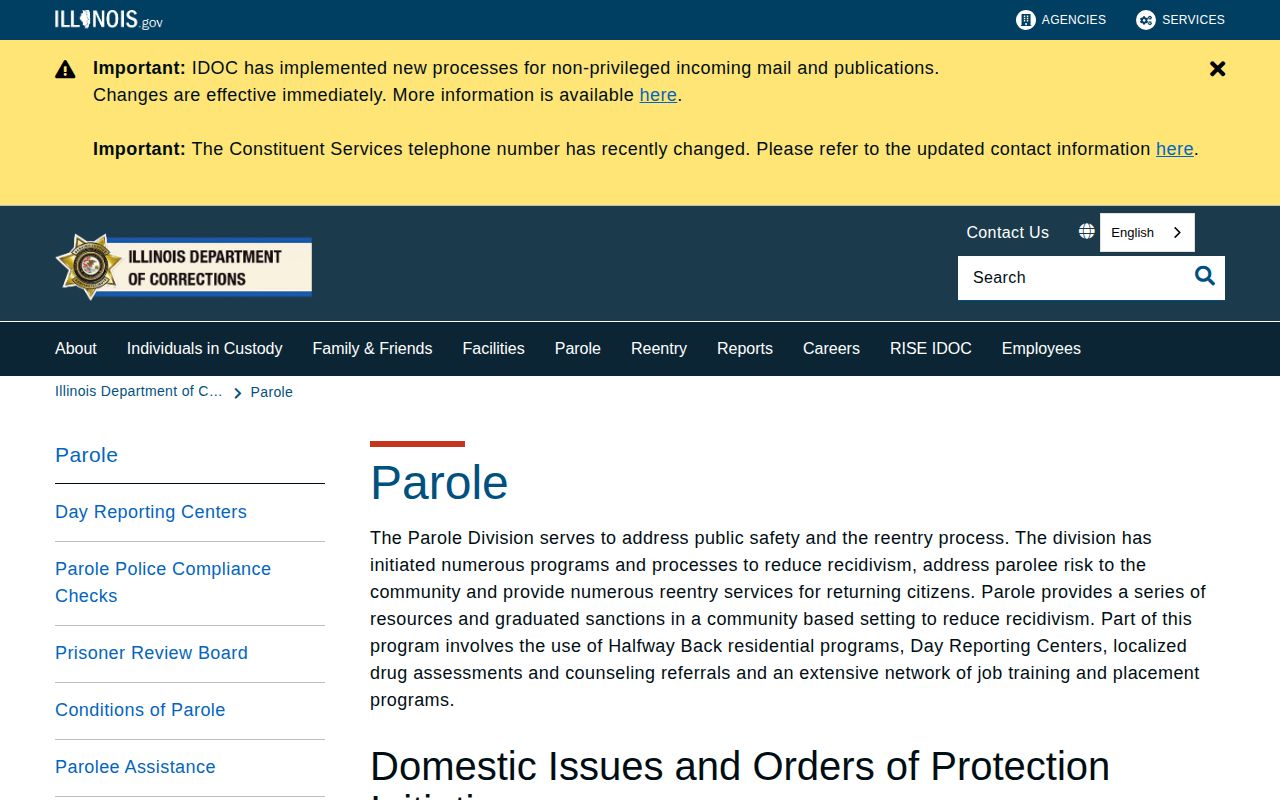
For a named status, the person's current IDOC profile remains more useful than a general program description.
Wabash County Supervision Offices
Wabash County has separate local and statewide routes. Contact the office tied to the record, and do not send private supervision details to an unrelated agency.
Wabash County Probation
Chief Probation Officer: Ryan Ruble
Address: 401 N. Market Street, Mt. Carmel, IL 62863
Phone: 618-262-8700
Illinois Department of Corrections Parole
Parole office or agent line: 800-666-6744
Main/Public Information: 217-558-2200
Mail: 1301 Concordia Court, PO Box 19277, Springfield, IL 62794-9277
The Second Circuit page also identifies Probation Officer Judy Lewis at the courthouse and a chief-office route in Carmi. The statewide judicial directory is the best published source for the local department contact, but a case number and court order are the stronger proof of a person's probation sentence.
The official directory image below shows the published local probation route. It supports office contact, not a public list of probationers.
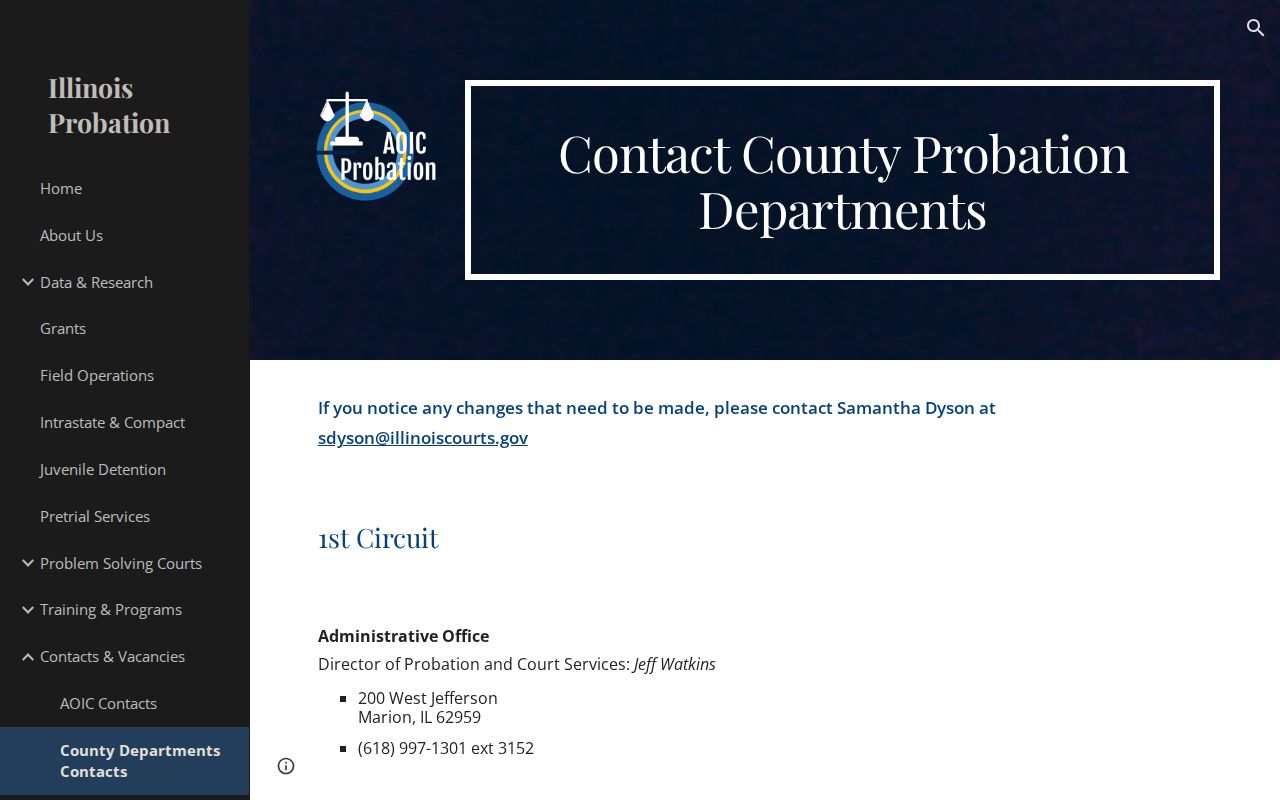
Callers should ask what public record is available and respect limits on case-management information.
Wabash County Pretrial Release Conditions
Pretrial supervision is distinct from parole and probation. The Wabash jail FAQ explains that Illinois ended cash bail for new cases on September 18, 2023. A detention hearing now determines whether a person remains held or leaves under conditions while the case is pending. Older warrants may still retain cash-bond terms, so the exact court order and warrant date matter.
Statewide Pretrial Services, Wabash
Officer: Angel “Dave” Romero
Phone: 217-691-2715
Email: aromero@ilosps.gov
Central office: 217-280-5873, PretrialServices@ilosps.gov
A person supervised here has not necessarily been convicted or sentenced. The circuit clerk's copy of the release order gives the legal terms, while the assigned officer administers the conditions.
Conditions and Violations in Wabash County Records
IDOC publishes general conditions of supervision, but a general page cannot prove the terms imposed on a named person. The operative order or supervision record controls. A reported breach can lead to a warrant, hearing, modification, or return to custody, yet an allegation is not the same as a final revocation result.
For probation, use the court docket and clerk's disposition. For parole or MSR, recheck the top-level IDOC status and parole district. Illinois Prisoner Review Board schedules and results can be relevant to specified revocation proceedings, while IDOC manages day-to-day parole supervision. These agencies perform different jobs and should not be treated as one office.
Note: A past release date can remain accurate even when a later warrant or custody event changes the person's current status.
Wabash County Absconder and Warrant Checks
IDOC's Wanted Fugitives page is a narrow subset, not a complete parole roster, probation directory, or warrant database. Finding a person there is a lead about an alleged supervision-location problem. Not finding a person there does not prove compliance or the lack of a warrant.
The captured official page shows why this channel must be read as a selected list. Recheck the named IDOC profile and any later board result before drawing a conclusion.
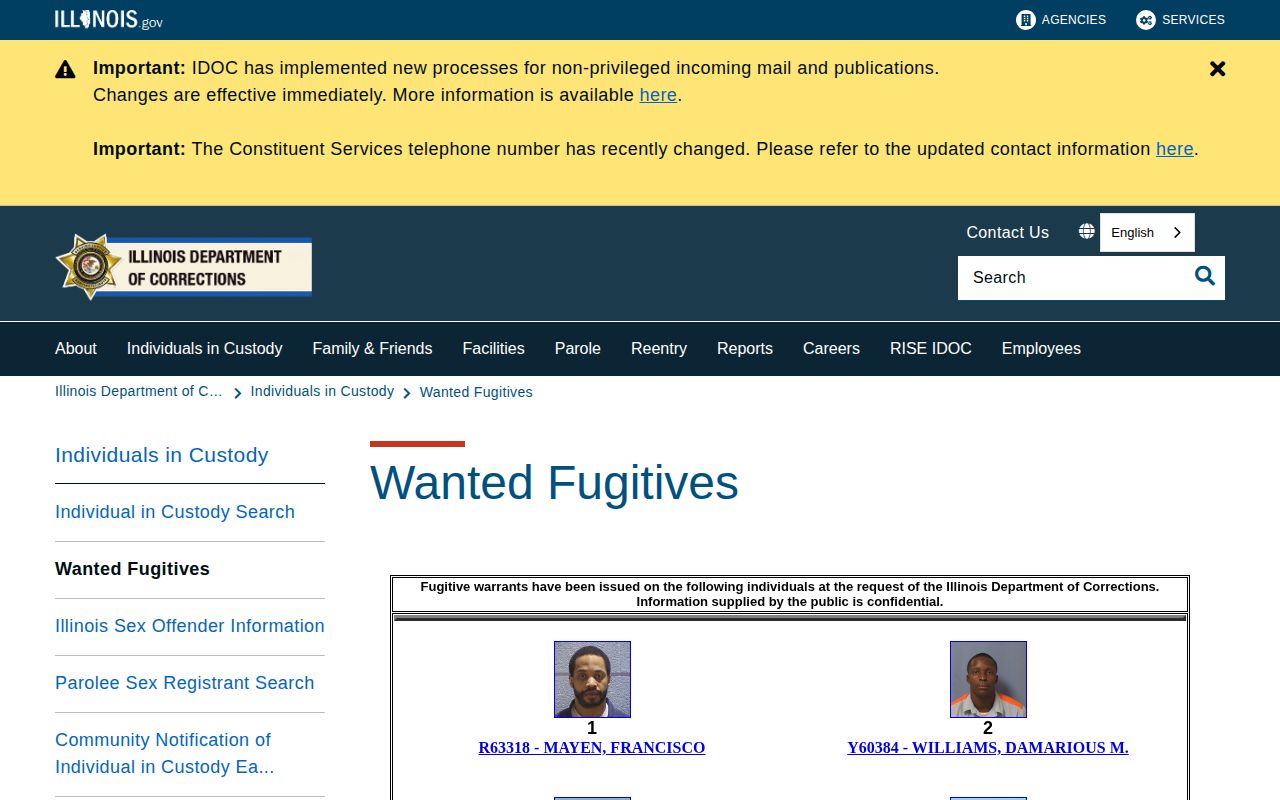
A warrant may lead to renewed custody, but only a current agency or court record can show what happened after it issued.
IDOC Transfer Property After a Wabash Jail Exit
A roster disappearance can reflect transfer to IDOC rather than release to the community. The Wabash jail FAQ states that specified identity and essential items may travel with an IDOC transferee. Other property is held for a designee for 30 days and disposed of on day 31. That rule applies to a transfer into state custody, not an ordinary community release.
This local detail can help a family identify the likely custody path, but property handling is not legal proof of transfer. Confirm the jail exit record and then locate the later IDOC admission profile. Contact the jail at 618-262-5531 about the current process and authorization for a designee before attempting pickup.
How Wabash County Supervision Ends
Physical release, release to supervision, and final discharge occur at different points. An IDOC Projected Discharge Date estimates the expected end of the sentence or supervision relationship. It is not proof that discharge took place. A public profile's historic parole date also cannot establish that the person remains on parole today.
For probation, obtain the court's termination, discharge, or final disposition record. For IDOC, seek the current profile and written confirmation of releasable discharge facts if the person has left the public search. Illinois law treats IDOC master files as confidential subject to specified access, so the existence of a final-discharge field does not guarantee public production.
Documenting Wabash County Supervision Status
Keep a dated copy of the current IDOC profile or court order, note the agency and identifier, and record which office confirmed the status. This creates a clear line between the original jail exit, the supervision term, any later warrant or return, and final discharge. If a public profile changes or disappears, the earlier dated record remains context but should not be presented as current proof.