
Projected and Actual Wabash County Release Dates
A projected date is a calculation based on the sentence and the facts known at that time. An actual release record says that the person left a specific custodian on a specific date. IDOC uses Projected Parole Date for the public estimate of exit from prison and Projected Discharge Date for the expected end of the sentence or supervision relationship. On a parole profile, Parole Date is an actual date.
Wabash County Jail and IDOC are separate systems. A county defendant held before trial may leave after a detention hearing, dismissal, transfer, or another court order, so there may be no sentence calculation at all. If the court imposes a local jail sentence, the jail calculates its record from the judgment and custody credit. If the court commits the person to IDOC, the state calculation applies after admission.
How to Run a Wabash County Release Date Lookup
First determine the custody system. A current app entry identifies county custody, but its disappearance does not state a date or destination. IDOC's search is for state prisoners and parolees, not a county-jail archive.
- Confirm identity. Gather the full name and a second identifier such as birthdate, booking number, IDOC number, or case number.
- For IDOC, open the official search. Choose Last Name, IDOC Number, or Birthdate, submit the value, and select the correct person.
- Read status before dates. Compare
Offender StatusandLocation, then review the admission, release, and discharge block and every sentence row. - For Wabash County Jail, obtain the judgment. Ask the Wabash Circuit Clerk for the sentencing or release order and its custody-credit finding.
- Ask the jail for its recorded calculation. Contact 618-262-5531. Do not apply an IDOC date or a general percentage to a local jail term.
- Confirm the event after the forecast. Use the actual jail release sheet, current IDOC parole status, or written agency confirmation.
The Wabash County released-inmate records guide covers the full jail, court, and receiving-agency verification chain for a named person.
IDOC Fields in a Wabash County Release Date Record
A Wabash sentence row in IDOC means the mittimus came from Wabash County. It does not place the person in the county jail. Read the result as layers, because one historic field can be misleading when separated from the current status.
| IDOC field | What it means |
|---|---|
| Offender Status | Current top-level state status, such as in custody or parole |
| Location | Current facility or parole district context shown by IDOC |
| Admission Date | Date of entry reflected in the state record |
| Projected Parole Date | Current estimate of release from incarceration |
| Parole Date | Actual date shown on a parole profile |
| Projected Discharge Date | Expected end of the sentence or supervision relationship |
| SENTENCE DISCHARGED?: YES/NO | Status of one sentence count, not necessarily the whole current record |
IDOC warns that its information changes quickly and advises written correspondence before assuming it is complete. Save the date of any screenshot. A return to custody, new sentence, court correction, credit change, or final discharge can alter the page.
The official example below shows how projected fields appear together on an in-custody record. It demonstrates labels and layout, not the calculation for a Wabash County person.
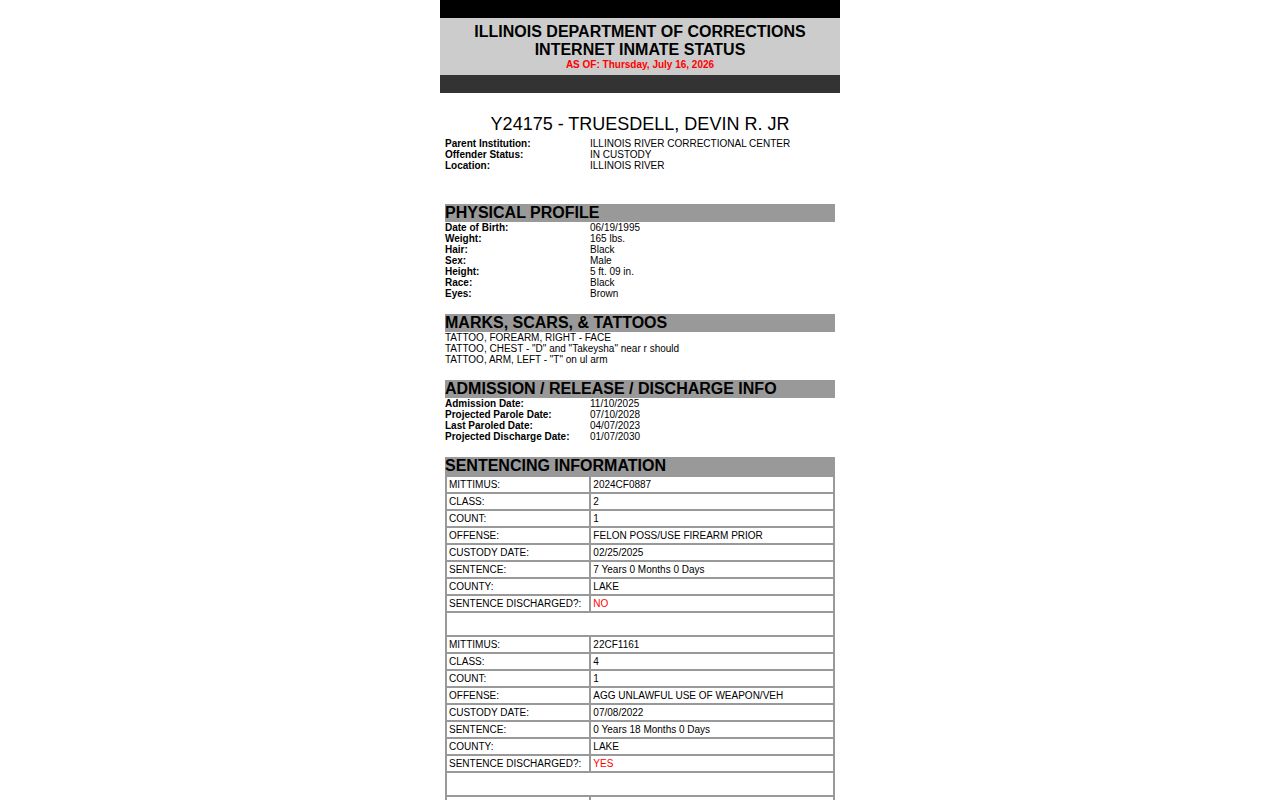
Always return to the named person's current record and compare all identity fields before using a date.
Illinois Sentence Credit for Wabash County Cases
Illinois does not use one universal 85-percent rule. 730 ILCS 5/3-6-3 creates offense-specific credit limits. The statutory version, offense date, sentence date, and exact offense all matter.
| General statutory category | Approximate effect described in the research | Critical limit |
|---|---|---|
| Specified first-degree murder and terrorism categories | Commonly described as 100 percent | No sentence credit for the identified category |
| Enumerated serious offenses | Roughly 85 percent served | No more than 4.5 days of credit per sentence month |
| Other listed drug, trafficking, gunrunning, money-laundering, and Class X categories | Roughly 75 percent served | No more than 7.5 days of credit per month |
| Offenses outside listed limits | Often called day-for-day or roughly 50 percent | Subject to all statutory qualifications and exceptions |
These bands are explanations, not a calculator. Consecutive and concurrent terms, jail credit, revoked or restored credit, lost time, recommitment, court orders, and additional earned credit can change the result. IDOC says it cannot predict whether or when Earned Discretionary Sentence Credit will be awarded. When a revision occurs, IDOC updates the public profile and notifies the person.
Note: Use the statute and judgment to understand a date, but use IDOC's current record to learn the date it actually calculated.
Why Wabash County Projected Dates Change
IDOC Administrative Directive 01.07.400 describes the calculation process. It incorporates available jail or custody credit, applies the relevant statutory credit, distinguishes determinate and indeterminate terms, and aggregates consecutive sentences. The statute and court judgment still control over a general explanation.
| Change | Possible effect | Where to verify |
|---|---|---|
| Credit awarded, revoked, or restored | Moves a projected date | Current IDOC profile and calculation record |
| Custody-credit correction | Changes credited time already served | Judgment, amended order, and agency calculation |
| New concurrent or consecutive sentence | Changes the combined term | Sentence blocks and court orders |
| Offense or statutory classification correction | Changes the credit rule applied | Court record, statute, and IDOC calculation |
| Escape or lost time | Can affect mandatory calculations | Agency record |
| MSR violation or return | Changes current custody and later dates | IDOC status and board record when applicable |
| Data correction | Changes the displayed value without a new release event | Dated profiles and written IDOC response |
Old-law indeterminate cases use minimum, maximum, and parole-eligibility concepts. Most post-1977 determinate prisoners are not released by a routine discretionary parole-board grant. They serve the term less authorized credit and enter mandatory supervised release. Qualifying youthful-parole cases are a separate statutory exception.
County Jail Dates in Wabash County Court Records
For a local jail sentence, obtain the sentencing order and custody-credit finding from the Wabash Circuit Clerk, then ask Wabash County Jail for its recorded calculation. The clerk is at 401 N. Market Street in Mt. Carmel and can be reached at 618-262-5362. The jail is at 110 E. Fourth Street and can be reached at 618-262-5531.
A pretrial detainee has no sentence-release date. The jail FAQ explains that a detention hearing determines detention or conditional pretrial release for modern Illinois cases. An older warrant may still carry cash-bond terms. The court order, not a sentence-percentage estimate, explains that kind of exit.
A court disposition can also reflect dismissal, probation, time served, transfer, or another result. Ask for the exact order and avoid treating the lack of a current roster entry as proof of any one outcome.
Confirming a Wabash County Actual Release
For an IDOC prisoner, current PAROLE status plus an actual Parole Date and district supports exit from prison to supervision. That is not final sentence discharge. For a county detainee, request the booking/release sheet and compare it with the court order. For a transfer, check the receiving system.
A pending custody notification can add a time-sensitive alert, and the VINE Inmate Check explains the Illinois process and its coverage limits. VINE is a secondary delivery service. The jail, IDOC, court, or receiving agency remains the source of the event.
Checking a Wabash County Date Over Time
A useful release-date record preserves what the agency showed and when it showed it. For IDOC, save the current status, location, projected parole date, projected discharge date, sentence county, and the date checked. Revisit the profile after the projected day. If the status still says in custody, the forecast did not establish an exit. If the status changes to parole, record the actual parole date and district while remembering that supervision continues.
For a local Wabash County term, keep the court judgment, custody-credit finding, and the jail response together. A later amended order may explain a changed calculation. If the person instead transferred to IDOC or another custodian, preserve the county release or transfer event and the receiving agency admission as two distinct records. This avoids a common error in which one agency disappearance is treated as community release.
Written confirmation is especially important after a public profile leaves the searchable scope. Ask IDOC only for releasable facts and cite the identifiers already verified. For the county jail, ask for the existing booking or release sheet rather than asking staff to create a narrative. A dated evidence chain is more accurate than a stale projected date, and it clearly separates the estimate, the physical exit, release to supervision, and final discharge.
Wabash County Determinate and Indeterminate Date Rules
IDOC date labels also depend on the type of sentence. Most post-1977 determinate prisoners generally do not wait for a routine discretionary parole grant under 730 ILCS 5/3-3-3. IDOC calculates the term less authorized credit and, when applicable, the person leaves incarceration for mandatory supervised release. The public interface may still call the estimate a Projected Parole Date. That label should be read as IDOC terminology, not proof that the Prisoner Review Board granted discretionary parole in the named case.
Old-law indeterminate cases use minimum, maximum, and parole-eligibility concepts. Qualifying youthful-parole cases form another statutory exception under 730 ILCS 5/5-4.5-115. Those cases cannot be explained by applying the ordinary determinate framework. The court judgment, offense and sentence dates, current statutory provisions, and agency calculation must identify which framework controls. When a hearing is legally relevant, a board agenda shows a scheduled proceeding, while minutes or results show an outcome. Neither alone replaces the current IDOC custody status.
Mandatory supervised release can also affect later records. A person may have a true actual Parole Date and then return to custody after an alleged violation or revocation process. Lost time outside supervision can affect mandatory calculations under the IDOC directive. A wanted-fugitive entry is only a limited allegation or location lead, not a final board result. Recheck the top-level profile, then use the correct hearing or court record to explain any later change.
For a Wabash County case, the sentence block should be tied back to the circuit-court judgment. Multiple counts may have different discharged flags, and a YES on one count can coexist with custody on another. Review every mittimus, class, count, offense, custody date, sentence, and county row. This full-record method keeps an old date, a single discharged count, or a projected field from being mistaken for current release.